
Spine Endoscopy: Procedure, Benefits, Risks & Recovery
Introduction
Persistent back pain, pain radiating into the legs, numbness or tingling can sometimes be associated with spinal conditions such as a herniated disc or spinal nerve compression.
When appropriate non-surgical treatments do not provide sufficient relief, a spine specialist may evaluate whether a surgical procedure is needed.
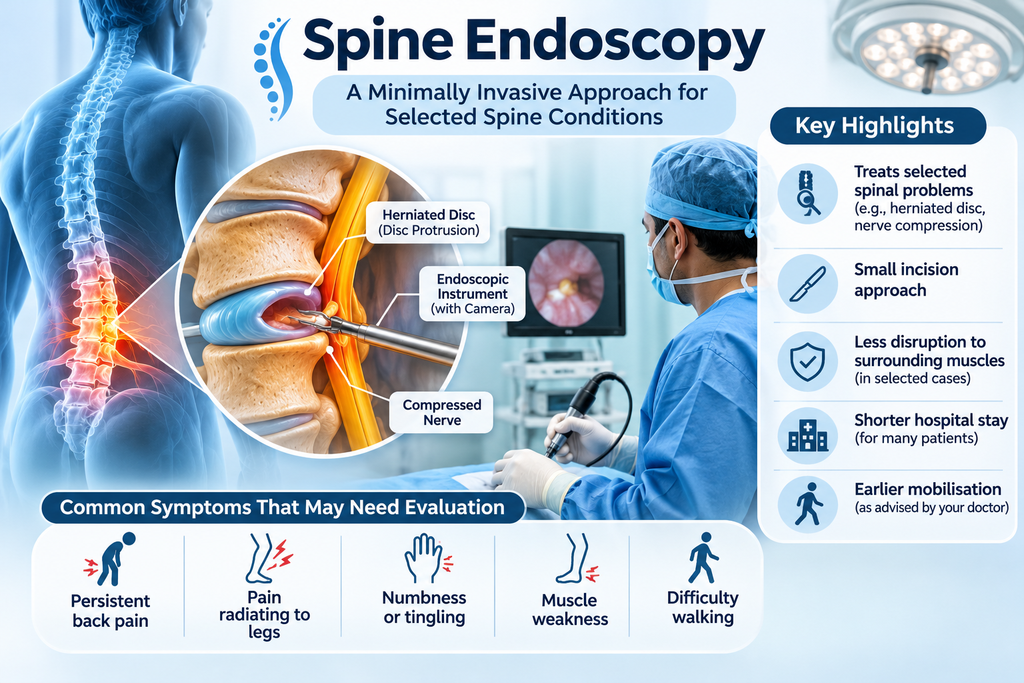
One surgical approach used in selected patients is spine endoscopy. It involves using a small camera and specialised instruments to access and treat certain spinal conditions through a relatively small incision.
Spine endoscopy is not suitable for every spinal problem. Understanding the procedure, possible benefits, limitations and risks can help patients make informed decisions with their treating specialist.
What Is Spine Endoscopy?
Spine endoscopy is a minimally invasive surgical technique used to examine and treat selected conditions affecting the spine.
During the procedure, a surgeon uses an endoscope, a thin instrument with a camera and light source. The camera provides magnified images of the surgical area on a monitor.
Specialised instruments are passed through the endoscopic access system to perform the required treatment.
Depending on the condition, the procedure may involve removing herniated disc material or relieving pressure on an affected spinal nerve.
Compared with some conventional open procedures, endoscopic techniques may use smaller skin incisions and cause less disruption to surrounding muscles. However, the actual approach and recovery depend on the individual procedure and patient’s condition.
Which Spinal Conditions May Be Treated Using Endoscopy?
Spine endoscopy may be considered for selected spinal conditions, particularly when a specific area of nerve compression can be accessed safely.
1. Herniated Disc
A herniated disc occurs when the inner material of a spinal disc protrudes through its outer layer. If the protruding material presses on a nearby nerve, it may cause back pain, leg pain, numbness or weakness.
Endoscopic discectomy may be considered in appropriately selected patients to remove the disc material compressing the nerve.
2. Lumbar Spinal Stenosis
Lumbar spinal stenosis refers to narrowing of the spinal canal or the spaces through which spinal nerves pass in the lower back.
In selected cases, endoscopic decompression may be used to remove structures contributing to nerve compression.
3. Foraminal Stenosis
The neural foramina are openings through which spinal nerves exit the spinal column. Narrowing of these openings can compress the nerves and cause radiating pain or other neurological symptoms.
An endoscopic approach may be considered in selected cases to relieve the compression.
4. Selected Cases of Nerve Compression
Certain conditions involving localised spinal nerve compression may be suitable for an endoscopic procedure, depending on their location and structural characteristics.
Not all cases of spinal stenosis, disc disease or spinal instability can be treated using endoscopy. A specialist assessment is necessary to determine suitability.
What Are the Symptoms That May Require a Spine Evaluation?
Symptoms vary depending on the spinal conditions and the nerves involved.
Common symptoms include:
- Persistent back pain: Pain in the lower back or another affected spinal region.
- Radiating leg pain: Pain that travels from the lower back into the buttocks or legs.
- Numbness and tingling: Altered sensation in the legs or feet.
- Muscle weakness: Reduced strength in the affected muscles.
- Difficulty walking: Discomfort or leg symptoms that interfere with walking.
- Movement-related pain: Symptoms that worsen during certain movements or activities.
These symptoms do not automatically mean that spine endoscopy is required. They can occur due to several different conditions and need proper clinical evaluation.
New loss of bladder or bowel control, numbness around the groin or saddle area, or rapidly worsening leg weakness requires emergency medical assessment.
How Is Spine Endoscopy Performed?
The exact procedure depends on the spinal condition, the affected level and the surgical approach selected by the treating surgeon.
1. Preoperative Assessment
Before surgery, the doctor reviews the patient’s symptoms, medical history, neurological examination and imaging results.
MRI, CT scans or X-rays may be used to understand the location and cause of spinal compression.
The patient may also undergo blood tests and anaesthesia assessment, depending on the planned procedure.
2. Anaesthesia
Spine endoscopy may be performed under local anaesthesia with sedation or general anaesthesia, depending on the procedure and the patient’s clinical requirements.
The anaesthesia plan is decided by the treating medical team.
3. Small Surgical Incision
A small incision is made at the planned access point. The endoscope and specialised instruments are introduced through the access system.
The exact incision size and approach vary according to the technique used.
4. Visualisation of the Affected Area
The endoscope transmits magnified images to a monitor, allowing the surgeon to visualise the relevant spinal structures.
5. Treatment of the Spinal Condition
Depending on the diagnosis, the surgeon may remove herniated disc material or selected tissues contributing to nerve compression.
The aim is to address the specific source of compression identified during preoperative assessment.
6. Completion of the Procedure
After the planned treatment is completed, the instruments are removed and the incision is closed using an appropriate technique.
The patient is then monitored during the postoperative period.
What Are the Potential Benefits of Spine Endoscopy?
For appropriately selected patients, an endoscopic approach may offer certain advantages compared with some conventional open procedures.
Potential benefits include:
- Smaller incision: The procedure generally uses a smaller access incision.
- Less muscle disruption: The approach may reduce disturbance to some surrounding muscles.
- Direct visualisation: The endoscope provides magnified views of the surgical area.
- Potentially shorter hospital stay: Some patients may be discharged earlier, depending on their condition and recovery.
- Earlier mobilisation: Selected patients may be able to start moving earlier after the procedure.
These potential benefits are not guaranteed. Outcomes vary according to the diagnosis, surgical technique, patient health and other clinical factors.
What Are the Risks and Possible Complications?
Like other surgical procedures, spine endoscopy has potential risks. Patients should discuss these with their surgeon before making a treatment decision.
Possible complications include:
1. Infection
An infection may develop at the surgical site or, rarely, involve deeper spinal structures.
2. Bleeding
Bleeding can occur during or after the procedure. The risk depends on the patient’s health and other factors, including medicines that affect blood clotting.
3. Nerve Irritation or Injury
The spinal nerves are located close to the surgical area. Irritation or injury may result in temporary or, in uncommon cases, persistent neurological symptoms.
4. Dural Tear or Cerebrospinal Fluid Leak
The dura is the protective membrane surrounding the spinal cord and nerves. A tear may result in leakage of cerebrospinal fluid and may require additional management.
5. Persistent or Recurrent Symptoms
Some patients may continue to experience pain or other symptoms after surgery. Disc herniation or nerve compression may also recur in certain cases.
6. Anaesthesia-Related Complications
As with other surgical procedures, complications related to anaesthesia may occur depending on the patient’s health and medical history.
The surgeon and anaesthesia team should explain the procedure-specific risks, alternatives and expected recovery before obtaining informed consent.
What Is the Recovery Process After Spine Endoscopy?
Recovery varies according to the type of procedure, the underlying spinal condition and the patient’s overall health.
Immediately After Surgery
Patients are monitored after the procedure. The medical team checks pain levels, movement and neurological function.
Some patients may be able to walk with assistance when medically appropriate.
First Few Days
The patient may receive instructions regarding wound care, medication, walking and activity restrictions.
The timing of discharge depends on clinical recovery and the treating team’s assessment.
Physiotherapy and Rehabilitation
A rehabilitation programme may be recommended depending on the procedure and the patient’s condition.
It may focus on:
- Gradual improvement in mobility.
- Safe movement techniques.
- Muscle strength and flexibility.
- Returning to appropriate daily activities.
Follow-Up Appointments
Follow-up visits help the treating doctor assess wound healing, neurological symptoms and functional recovery.
Patients should follow individual instructions regarding driving, exercise, lifting weights and returning to work.
Spine Endoscopy vs Conventional Open Spine Surgery
Both techniques have a role in treating spinal conditions. The choice depends on the patient’s diagnosis and surgical requirements.
| Feature | Spine Endoscopy | Conventional Open Surgery |
|---|---|---|
| Surgical access | Small access incision | Generally larger incision |
| Visualisation | Endoscopic camera | Direct surgical exposure |
| Muscle disruption | May be less in selected procedures | May involve greater muscle exposure |
| Treatment suitability | Selected spinal conditions | A wider range of spinal conditions |
| Recovery | Depends on procedure and patient | Depends on procedure and patient |
A smaller incision does not automatically mean that one approach is safer or more effective for every patient. Some complex spinal conditions may require a conventional or different minimally invasive surgical approach.
Who May Be Suitable for Spine Endoscopy?
Suitability depends on several factors, including:
- The exact spinal diagnosis.
- The location and extent of nerve compression.
- MRI or other imaging findings.
- Whether symptoms match the imaging findings.
- Previous spinal surgeries.
- Overall medical health and anaesthesia risk.
- The technical feasibility of the planned approach.
Patients with certain complex spinal deformities, significant instability, extensive scarring from previous surgery or other medical conditions may require a different treatment approach.
A specialist should evaluate the expected benefits and risks before recommending surgery.
When Should You Consult a Spine Specialist?
Consider medical evaluation if you experience:
- Persistent back pain that affects everyday activities.
- Pain radiating from the back into the legs.
- Numbness or tingling in the legs or feet.
- Muscle weakness.
- Difficulty walking or standing for extended periods.
- Symptoms that continue despite appropriate non-surgical treatment.
New bladder or bowel dysfunction, saddle-area numbness or rapidly worsening leg weakness requires emergency assessment rather than a routine appointment.
Spine Endoscopy Evaluation in Hyderabad
People experiencing persistent back pain, radiating leg pain or symptoms associated with spinal nerve compression may require a detailed spine evaluation.
The assessment may include a medical history, neurological examination and imaging studies such as MRI or CT scans when indicated.
For patients in Hyderabad and nearby areas of Telangana and Andhra Pradesh, treatment planning should be based on the specific spinal condition, imaging findings and overall health.
Spine endoscopy may be considered in selected cases. Other non-surgical or surgical approaches may be more appropriate depending on the individual diagnosis.
Frequently Asked Questions
1. What is spine endoscopy?
Spine endoscopy is a minimally invasive surgical technique that uses a small camera and specialised instruments to treat selected spinal conditions through a small access incision.
2. Is spine endoscopy suitable for every slipped disc?
No. Suitability depends on the location, size and type of disc herniation, nerve compression and the patient’s clinical condition. Not every slipped disc requires surgery.
3. Is spine endoscopy a minimally invasive procedure?
Yes. It is generally classified as a minimally invasive spinal procedure because it uses an endoscope and a relatively small surgical access point. The degree of tissue disruption varies with the technique.
4. What are the possible risks of spine endoscopy?
Possible risks include infection, bleeding, nerve irritation or injury, dural tear, cerebrospinal fluid leakage, persistent symptoms and recurrence of disc herniation.
5. How long does recovery take after spine endoscopy?
Recovery time varies according to the procedure, the spinal condition and the patient’s health. The treating surgeon provides individual guidance about walking, work, driving and exercise.
6. Can spine endoscopy treat spinal stenosis?
Endoscopic decompression may be considered for selected cases of spinal stenosis. The suitability depends on the location and severity of narrowing and the overall spinal structure.
7. Does spine endoscopy require general anaesthesia?
Not always. Depending on the procedure and the patient’s clinical needs, it may be performed under local anaesthesia with sedation or general anaesthesia.
8. Is spine endoscopy better than open surgery?
Neither approach is universally better. The appropriate procedure depends on the diagnosis, anatomy, surgical goals, patient health and the surgeon’s assessment.
Conclusion
Spine endoscopy is a minimally invasive surgical technique used to treat selected conditions involving spinal disc problems and nerve compression.
It uses an endoscopic camera and specialised instruments to access the affected area through a small surgical incision. Potential benefits may include less muscle disruption and earlier mobilisation in appropriately selected patients.
However, the procedure has limitations and possible complications. Not every spinal condition can be treated through endoscopy, and surgery is not necessary for every patient with back pain or a slipped disc.
A detailed clinical evaluation helps determine whether spine endoscopy, another surgical approach or non-surgical management is appropriate.
Medical Disclaimer: This article is intended for general educational purposes only. It does not replace professional medical advice, diagnosis or treatment. Spine endoscopy may not be suitable for every patient. Treatment decisions should be made after individual assessment by a qualified specialist. Seek emergency medical care for new bladder or bowel dysfunction, saddle-area numbness or rapidly worsening leg weakness.