
Spondylolisthesis: Symptoms, Causes & Treatment
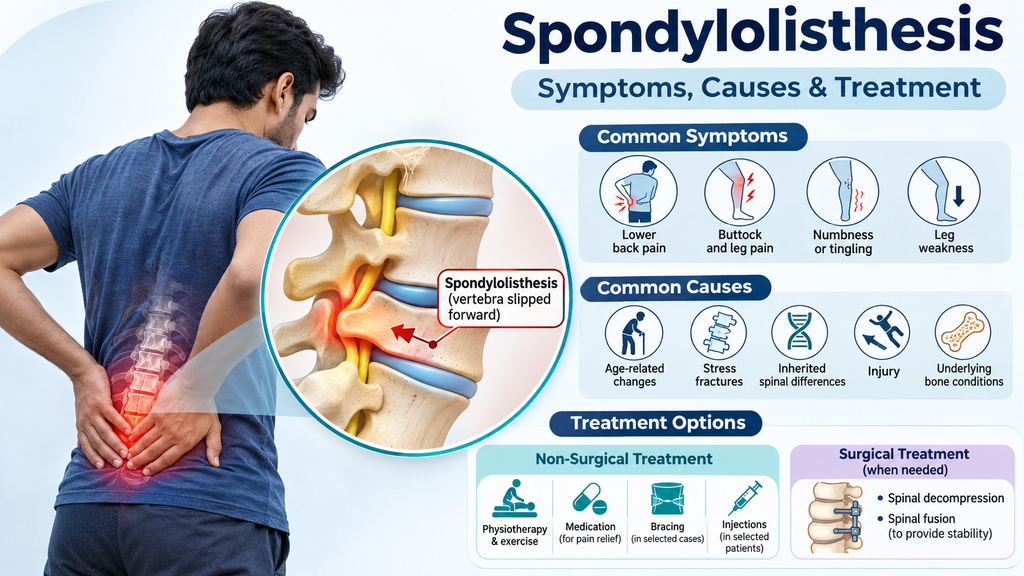
Lower back pain that worsens while standing or walking, tightness in the thighs, or pain spreading from the back to the legs may sometimes indicate a spinal condition called spondylolisthesis. Some people have no noticeable symptoms, while others may experience persistent discomfort, difficulty walking or symptoms caused by pressure on nearby nerves.
Understanding spondylolisthesis, its causes, diagnosis and treatment options can help patients make informed decisions about their spine health. Medical evaluation is important when symptoms persist, worsen or are accompanied by neurological changes.
What Is Spondylolisthesis?
Spondylolisthesis is a condition in which one vertebra slips forward relative to the vertebra below it. It most commonly affects the lower back, particularly the lumbar spine.
The vertebrae support the body and protect the spinal cord and nearby nerve structures. When a vertebra shifts out of alignment, it may cause back pain or contribute to narrowing around the spinal nerves.
The severity varies between individuals. Some cases remain stable without symptoms, while others may require treatment to manage pain or address nerve compression.
Types of Spondylolisthesis
The main types include:
- Degenerative spondylolisthesis: Develops when age-related changes and arthritis affect the discs and joints that help stabilise the spine.
- Isthmic spondylolisthesis: Occurs when a defect or stress fracture develops in a small part of the vertebra called the pars interarticularis.
- Congenital spondylolisthesis: Results from differences in spinal bone development present from birth.
- Traumatic spondylolisthesis: Develops following an injury that damages supporting spinal structures.
- Pathologic spondylolisthesis: Occurs when an underlying condition, such as a tumour or bone disease, weakens a vertebra.
Identifying the type helps the treating specialist assess the condition and consider appropriate management.
What Are the Symptoms of Spondylolisthesis?
Symptoms depend on the degree of vertebral slippage, spinal stability and whether nearby nerves are affected. Some people may not experience any symptoms.
Common symptoms include:
- Lower back pain: Discomfort that may worsen with prolonged standing, walking or physical activity.
- Buttock and leg pain: Pain that travels from the lower back into the buttocks or thighs.
- Tight hamstrings: Stiffness in the muscles at the back of the thighs.
- Numbness or tingling: Unusual sensations in the legs or feet when nerves are affected.
- Leg weakness: Reduced strength that may make walking or daily activities difficult.
- Difficulty standing or walking: Some people experience symptoms that improve when sitting or bending forward.
These symptoms can occur with several spinal conditions and do not confirm spondylolisthesis on their own. A clinical assessment is needed to identify the cause.
When Are Symptoms an Emergency?
Seek emergency medical care if you develop:
- New loss of bladder or bowel control.
- Difficulty passing urine.
- Numbness around the groin or saddle area.
- Rapidly worsening leg weakness.
These symptoms may indicate serious nerve compression and require immediate evaluation.
What Causes Spondylolisthesis?
Spondylolisthesis can develop for several reasons, including:
- Age-related changes: Wear and tear affecting spinal joints and discs may reduce spinal stability.
- Stress fractures: Repeated stress on the pars interarticularis may contribute to vertebral slippage.
- Inherited spinal differences: Certain structural differences present from birth may increase the likelihood of the condition.
- Injury: Trauma can damage the bones and supporting structures of the spine.
- Underlying bone conditions: Certain diseases can weaken spinal structures.
Older age, osteoarthritis, family history and participation in some repetitive extension-based sports may be associated with an increased risk. However, having a risk factor does not necessarily mean a person will develop the condition.
How Is Spondylolisthesis Diagnosed?
Diagnosis involves reviewing symptoms, examining the spine and selecting appropriate imaging tests.
1. Medical History and Physical Examination
A spine specialist may assess pain patterns, posture, walking ability, muscle strength, flexibility and neurological function. This helps determine whether symptoms may be related to spinal instability or nerve compression.
2. X-rays
Spinal X-rays help identify vertebral slippage and estimate its severity. Additional views may be recommended when necessary to assess spinal alignment or movement.
3. MRI Scan
Magnetic resonance imaging (MRI) provides detailed images of soft tissues and nerve structures. It may help identify nerve compression, disc changes or narrowing around the spinal canal.
4. CT Scan
A computed tomography (CT) scan provides detailed images of bone. It may be useful when a specialist needs to evaluate a suspected pars defect or another bony abnormality.
Understanding the Grades of Spondylolisthesis
Doctors may classify vertebral slippage using the Meyerding grading system.
| Grade | Approximate forward slippage |
|---|---|
| Grade I | Up to 25% |
| Grade II | More than 25% to 50% |
| Grade III | More than 50% to 75% |
| Grade IV | More than 75% to 100% |
| Grade V (spondyloptosis) | More than 100% |
The grade describes the degree of slippage, but it does not determine treatment by itself. Symptoms, nerve function, spinal stability and overall health also influence treatment decisions.
What Are the Treatment Options for Spondylolisthesis?
Treatment depends on the cause, severity, symptoms and whether the condition is progressing. Not everyone with spondylolisthesis needs surgery.
Non-Surgical Treatment
For many patients, treatment initially focuses on managing symptoms and improving function.
- Activity modification: Temporarily reducing activities that aggravate symptoms, such as heavy lifting or repeated backward bending.
- Physiotherapy: A personalised programme may help improve core strength, flexibility, posture and movement.
- Medication: A doctor may recommend suitable pain-relieving or anti-inflammatory medication after considering the patient’s medical history and potential risks.
- Bracing: A spinal brace may be appropriate in selected cases, depending on the underlying cause and clinical assessment.
- Injections: Selected patients may be offered injections near affected nerves to help manage symptoms. Relief may be temporary, and injections do not correct vertebral slippage.
Exercise should be tailored to the individual. If symptoms are significant, seek professional guidance before starting strenuous exercises or following online exercise routines.
When Is Surgery Considered?
A spine specialist may consider surgery when:
- Persistent pain continues despite an appropriate course of non-surgical treatment.
- Nerve compression causes significant or progressive weakness.
- Spinal slippage or deformity progresses.
- Symptoms substantially interfere with walking, daily activities or quality of life.
The decision depends on the complete clinical picture, not simply the presence of spondylolisthesis or its grade.
Surgical Treatment Options
Depending on the patient’s condition, treatment may involve:
- Spinal decompression: Removes selected bone or tissue to relieve pressure on affected nerves.
- Spinal fusion: Joins the affected vertebrae using bone graft material and, when appropriate, screws and rods to provide stability.
These procedures may be performed together in selected cases. Surgery has potential risks, including infection, bleeding, nerve injury and problems with bone fusion. The treating specialist should explain the expected benefits, risks and alternatives before treatment.
Recovery and Spine Health
Recovery varies according to the severity of the condition, the treatment performed and the individual’s general health.
After surgery, the care team may recommend gradual increases in activity, follow-up appointments and rehabilitation. Patients should follow individual instructions regarding lifting, exercise and returning to daily routines.
Some general measures that support spine health include:
- Maintaining a healthy body weight.
- Following an appropriate exercise programme.
- Using safe lifting techniques.
- Avoiding activities that consistently aggravate symptoms.
- Seeking medical advice for persistent back pain or new neurological symptoms.
These measures support general spine health but cannot guarantee prevention of spondylolisthesis.
Frequently Asked Questions
1. Is spondylolisthesis the same as a slipped disc?
No. Spondylolisthesis involves one vertebra shifting relative to another. A herniated disc occurs when disc material protrudes beyond its usual boundaries. Both conditions can sometimes contribute to back or leg pain.
2. Can spondylolisthesis be treated without surgery?
Yes. Many patients can manage their symptoms with activity modification, physiotherapy and other appropriate non-surgical treatments. The best approach depends on individual symptoms and clinical findings.
3. Can I exercise if I have spondylolisthesis?
Some forms of exercise may be beneficial, but suitable activities depend on the cause, severity and symptoms. A doctor or physiotherapist can recommend an appropriate programme.
4. Does every severe case require surgery?
Not necessarily. The degree of slippage is one consideration. Symptoms, neurological findings, progression and the effect on daily activities also influence whether surgery is appropriate.
5. When should I consult a spine specialist?
Consult a specialist if back pain persists, leg pain or numbness develops, or walking becomes difficult. Seek emergency care for new bladder or bowel dysfunction, saddle-area numbness or rapidly worsening weakness.
Conclusion
Spondylolisthesis can range from a stable spinal condition without symptoms to a problem that causes persistent pain or nerve compression. An appropriate diagnosis helps determine whether monitoring, non-surgical treatment or surgery may be suitable.
If you experience ongoing lower back pain, leg symptoms or difficulty walking, seek a clinical evaluation to identify the cause and discuss appropriate treatment options.
Medical Disclaimer: This article is for educational purposes only and is not a substitute for professional medical advice, diagnosis or treatment. Treatment decisions should be made by a qualified healthcare professional after an individual assessment. Seek emergency medical care for new bladder or bowel dysfunction, saddle-area numbness or rapidly worsening weakness.